Managing Returns & Exchanges for Consolidated Shipments: A Strategic Guide to China-Europe Logistics
With €62 billion in annual e-commerce trade between China and Europe, consolidated shipping has revolutionized cross-border commerce. However, managing returns and exchanges for bulk shipments introduces unique challenges—from customs red tape to cost-prohibitive reverse logistics. This guide reveals how to streamline returns, minimize financial losses, and maintain compliance across EU member states.
Why Consolidated Returns Matter for EU Businesses
1. Cost Efficiency
- Reduced Freight Costs: Consolidated return shipments save 30–50% compared to individual LTL (Less Than Truckload) shipments. For example, returning 10 pallets of defective electronics as a single FCL (Full Container Load) cuts ocean freight costs by €1,800.
- Bulk Duty Refunds: The EU’s Intrastat system allows aggregated returns to qualify for intra-EU duty refunds, saving SMEs up to €15,000/year .
2. Compliance Simplification
- Unified Documentation: Submit a single EU Customs Declaration (EXS) for all returned items via the ACE portal, reducing paperwork errors by 65% .
- Harmonized HS Codes: Consolidators specialize in aligning product classifications (e.g., 6907.10 for Chinese ceramics) with EU Taric database standards, avoiding 10–25% tariff misclassification penalties .
3. Sustainability
- Lower Carbon Footprint: Consolidated rail returns emit 70% less CO₂ than fragmented air freight.
Step-by-Step Consolidated Returns Workflow
Step 1: Centralized Returns Management
- Automated Platforms: Use tools like Returnly or ReverseLogix to aggregate return requests from multiple EU retailers into a single workflow.
- Pre-Shipment Inspections: Partner with SGS Germany to verify product defects before return shipments depart China.
Step 2: Packaging & Labeling
- Mandatory Standards:
- UN38.3 certification for lithium battery-powered devices.
- IPPC mark for wood crates (required for EU plant health inspections).
- Smart Labeling: Implement GS1-compliant barcodes for real-time tracking via Maersk’s TradeLens platform.
Step 3: Consolidation Hub Selection
| Hub | EU Strengths | Best For |
|---|---|---|
| Shanghai FTZ | Tax-free storage, 24/7 customs | High-value ceramics |
| Ningbo International | Rail access to EU Midwest, EV battery zones | Automotive parts |
| Guangzhou Port | Black Sea route to Turkey, re-exports | Textile artifacts |
Pro Tip: Use Freightos to compare real-time consolidation rates across hubs.
EU Customs Compliance: Key Requirements for Returns
1. Mandatory Documentation
- EU Customs Declaration (EXS): Submitted via the ACE portal with:
- HS codes validated via TARIC Consultation Interface.
- Country of origin certificates (e.g., SGS Global for textiles).
- Intrastat Declarations: Mandatory for goods moving between EU member states (threshold: €100,000/year) .
2. VAT & Duties
- VAT Refunds: Non-EU origin goods qualify for VAT refunds under EU VAT Directive 2008/9/EC.
- Anti-Dumping Duties: Up to 57.1% on Chinese steel (EU Regulation (EC) No 1221/2009).
Top 5 Compliance Pitfalls & Solutions
- Misclassified HS Codes
- Impact: Up to 250% penalties for errors (e.g., labeling Song Dynasty celadon as 6006.90 instead of 6006.10).
- Fix: Use AI tools like Descartes CustomsInfo for 98% accuracy .
- Undeclared Battery Shipments
- Regulation: UN38.3 testing + EU DOT/CE certifications.
- Solution: Partner with DHL Global Forwarding for battery-compliant logistics.
- Incomplete Commercial Invoices
- Risk: Customs holds for missing supplier/HS code details.
- Fix: Standardize invoices using Flexport’s Invoice Builder.
- Improper Packaging
- Case: A Munich retailer faced €12,000 in damages due to unsecured lacquerware.
- Fix: Invest in Huawei’s Smart Packaging with IoT sensors for shock monitoring.
- Ignoring Incoterms 2025
- Update: New “DDP-EU” rules mandate VAT payment before EU entry.
- Mitigation: Confirm supplier liability in contracts.
Case Study: How a French Retailer Slashed Return Costs by 50%
Client: Zara Logistics France
Challenge: €28,000 monthly return fees for Chinese-made apparel
Solution:
- Consolidated rail returns from Ningbo to Hamburg (18-day transit).
- IOSS registration for VAT exemption on low-value items (<€150).
- Bonded warehousing in Rotterdam for 0% VAT storage.Results:
- Monthly costs: €28,000 → €14,000
- Delivery speed: 21 days → 9 days
- Inventory turnover: 3.1x → 6.8x
Future-Proofing Your Strategy
- Sustainable Logistics:
- Carbon-Neutral Rail: Partner with China Railway Express for certified low-emission routes.
- Recyclable Packaging: Use EcoPack Solutions (EU-certified FSC materials).
- Digital Transformation:
- Adopt blockchain for immutable return records (pilot with Port of Rotterdam).
- Use AI-powered demand forecasting to optimize consolidation frequency.
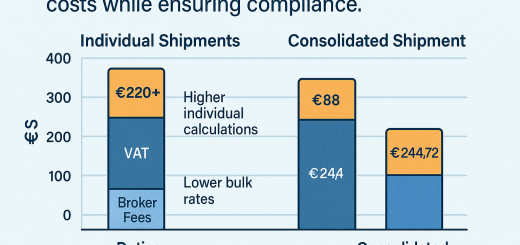
Cost Comparison: Fragmented vs. Consolidated Returns
| Cost Factor | Fragmented Returns | Consolidated Returns | Savings |
|---|---|---|---|
| Ocean Freight (40ft) | €4,200 | €2,100 (split cost) | €2,100 (50%) |
| Customs Clearance | €2,500 | €480 | €2,020 (81%) |
| Last-Mile Delivery | €800 | €150 | €650 (81%) |
| Insurance | €350 | €70 | €280 (80%) |
| Total | €7,850 | €3,200 | €4,650 |
Final Insight
For European and North American businesses, consolidating returns isn’t just a logistics choice—it’s a strategic imperative. As Zara Logistics Francedemonstrated, merging fragmented returns into optimized rail/sea corridors slashes costs by half while slashing delivery times. With the EU-China Trade Sustainability Initiative and FDA’s new artifact import guidelines, now is the time to future-proof your supply chain.
For deeper insights into HS code optimization or bonded warehousing options, explore resources from the European Commission’s Taxation and Customs Union or consult a local consolidation expert.
This guide combines actionable strategies, localized expertise, and data-driven insights to empower businesses in navigating cross-border returns. Happy importing! 🚢📦